
A Unified Trust Architecture for Secured Voting Systems and a Hedge Against Inflation: An Advanced Framework Towards Sustainable Blockchains
DOI:
https://doi.org/10.62019/wrk70h63Keywords:
Blockchain, Voting Systems, Inflation Hedge, Trust Architecture, Cryptographic Verification, Decentralized Governance, Scarcity Mechanism, Electoral Integrity, Monetary Credibility, Distributed Consensus.Abstract
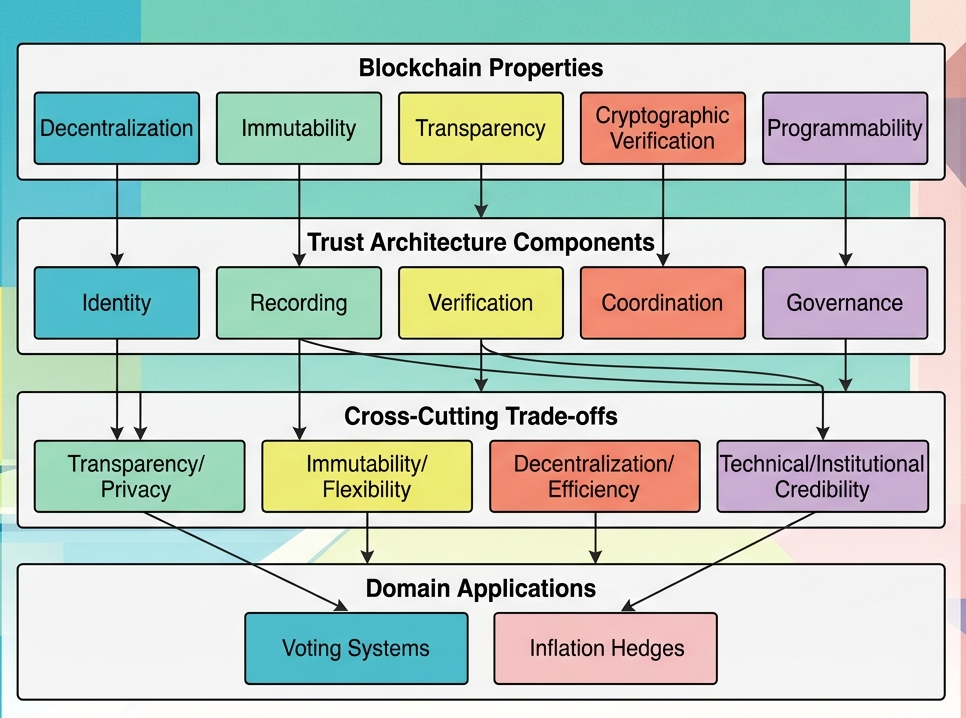
The dual crises of electoral integrity and monetary stability share a common cause: the loss of trust in centralized systems. This paper develops a unified approach for the study of blockchain-based systems for trust, verification, and scarcity logic in two domains: voting systems and inflation hedging. By analyzing the properties of blockchain-based systems for trust, verification, and scarcity logic, we show that blockchain enables the transition from trust-based to verification- based systems. In voting systems, blockchain-based systems offer cryptographic verification for the integrity of voting outcomes without compromising ballot secrecy through the use of advanced cryptography. In monetary systems, blockchain-based systems offer transparent scarcity logic and verification for the constraints imposed by the monetary supply. Our analysis, however, reveals the limitations of blockchain-based voting systems for coercion resistance and the limitations of blockchain-based monetary assets for long-term credibility. The unified approach identifies the components of trust architecture for identity, recording, verification, coordination, and governance as key determinants for the success of blockchain-based systems. The comparative analysis reveals that the key benefit of blockchain-based systems is not the properties of the system but the ability to distribute trust among verification mechanisms. We develop a conceptual model for the design of hybrid systems for the integration of blockchain-based verification and institutional systems. The unified approach contributes to the literature on blockchain by providing tools for the evaluation of blockchain-based systems for various applications in the domains of governance and economics.
Downloads
Published
Issue
Section
License

This work is licensed under a Creative Commons Attribution-NonCommercial-NoDerivatives 4.0 International License.
How to Cite