
Assessing application of Blockchain, Artificial Intelligence, and Cloud-Computing in e-Governance
DOI:
https://doi.org/10.62019/06tbjw31Abstract
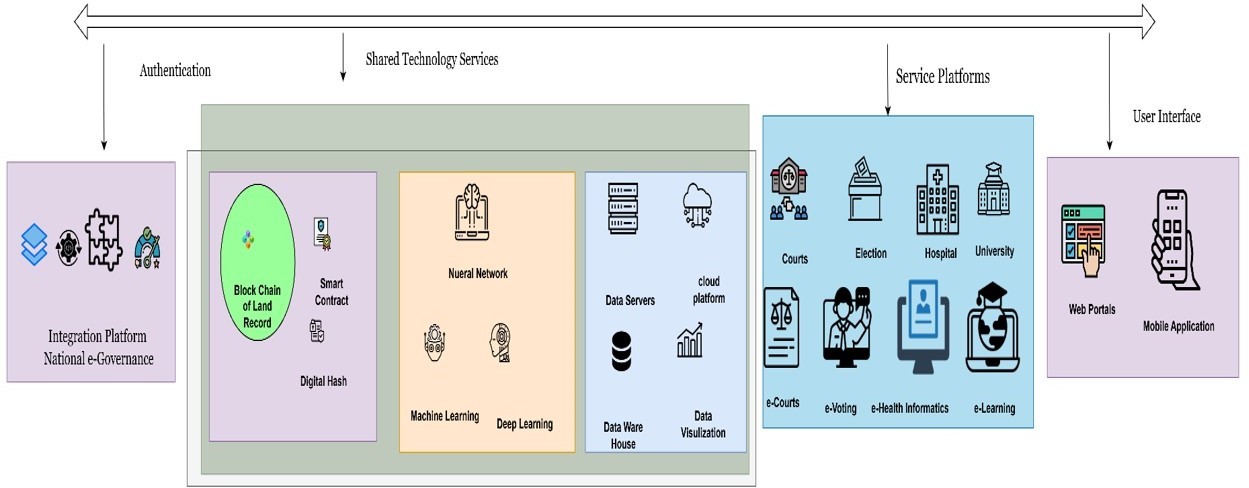
Administrative setups in developing countries face hurdles due to traditional manual processing of daily government affairs. Further, lack of transparency, delayed service and irregularities aggravate these challenges despite partial computerization. Conventional, data storages are subject to unauthorized modification, inefficient data registers and lack of coordination among administrative agencies. Establishment of decentralized, transparent, fraud-resilient and digitized e- governance infrastructure becomes inevitable to address these challenges. In this study, we outline e-governance model that particularly allows workflow automation of administrative affairs leveraging blockchain-based immutability, AI powered data analytics and cloud-computing services. The proposed architecture is further expanded to determine its efficacy in healthcare, electoral process and supply chain management. We conducted an analytical study to formulate modular architecture of these critical e-governance service. We also carried out experimental evaluation using blockchain based implementation for tamper- resistant, secure and anonymized public record registration. Results of this study shall help towards development scalable, interoperable and digitized e-governance model.
Downloads
Published
Issue
Section
License
Copyright (c) 2026 Mohsin Shaikh, Abdul Aziz Memon, Khalil Rauf, Ashfaq Ahmed, Shah Nawaz Khuhro

This work is licensed under a Creative Commons Attribution-NonCommercial-NoDerivatives 4.0 International License.
How to Cite