
AI-Driven Cybersecurity for Industrial Control Systems Using Graph and Time-Series Learning
DOI:
https://doi.org/10.62019/x60tt634Keywords:
Industrial Control Systems, cybersecurity, anomaly detection, graph learning, time-series learning, hybrid model, intrusion detectionAbstract
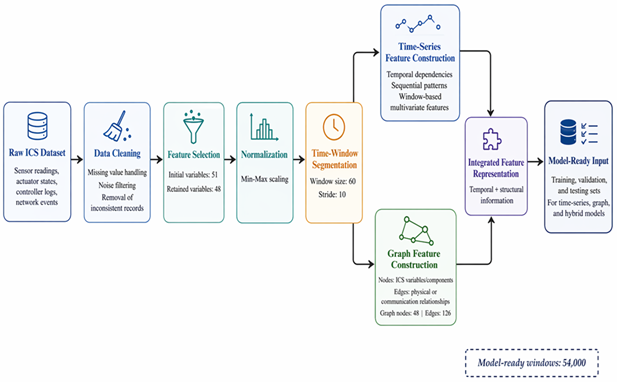
Industrial Control Systems (ICS) are increasingly exposed to cyber threats because of growing connectivity between operational technology and digital networks. Traditional security solutions mostly lack the ability to record sophisticated patterns of attacks that are dynamic and can disseminate across interdependent components. The purpose of the study was to create and test an AI-assisted cybersecurity framework of ICS based on graph learning, and time-series learning to enhance anomaly and intrusion detection. A quantitative experimental design was taken with preprocessed ICS data with normal and attack records. This was tested on three models including a time series model, a graph learning model, and a hybrid model that unites both the branches using feature fusion. Accuracy, precision, recall, F1-score, false positive rate, and detection delay, were used to measure performance. The hybrid model had the highest performance with the accuracy of 97.99%, precision 97.85, recall 97.11, and F1-score of 97.48. It also had the lowest false positive rate of 1.42% and the shortest detection delay of 3.1 seconds, compared to the standalone time-series and graph models. Temporal and structural learning can greatly empower ICS cybersecurity. The hybrid framework is a more operationally secure, fast, and more accurate way of detecting cyber threats in the industrial community and cut back the attacks missed as well as the consistency in detection across the board.
Downloads
Published
Issue
Section
License

This work is licensed under a Creative Commons Attribution-NonCommercial-NoDerivatives 4.0 International License.
How to Cite