
Escalating Cyber Threats: Analyzing Trends, Risks, and Countermeasures in Critical Sectors
DOI:
https://doi.org/10.62019/p3pfmt40Abstract
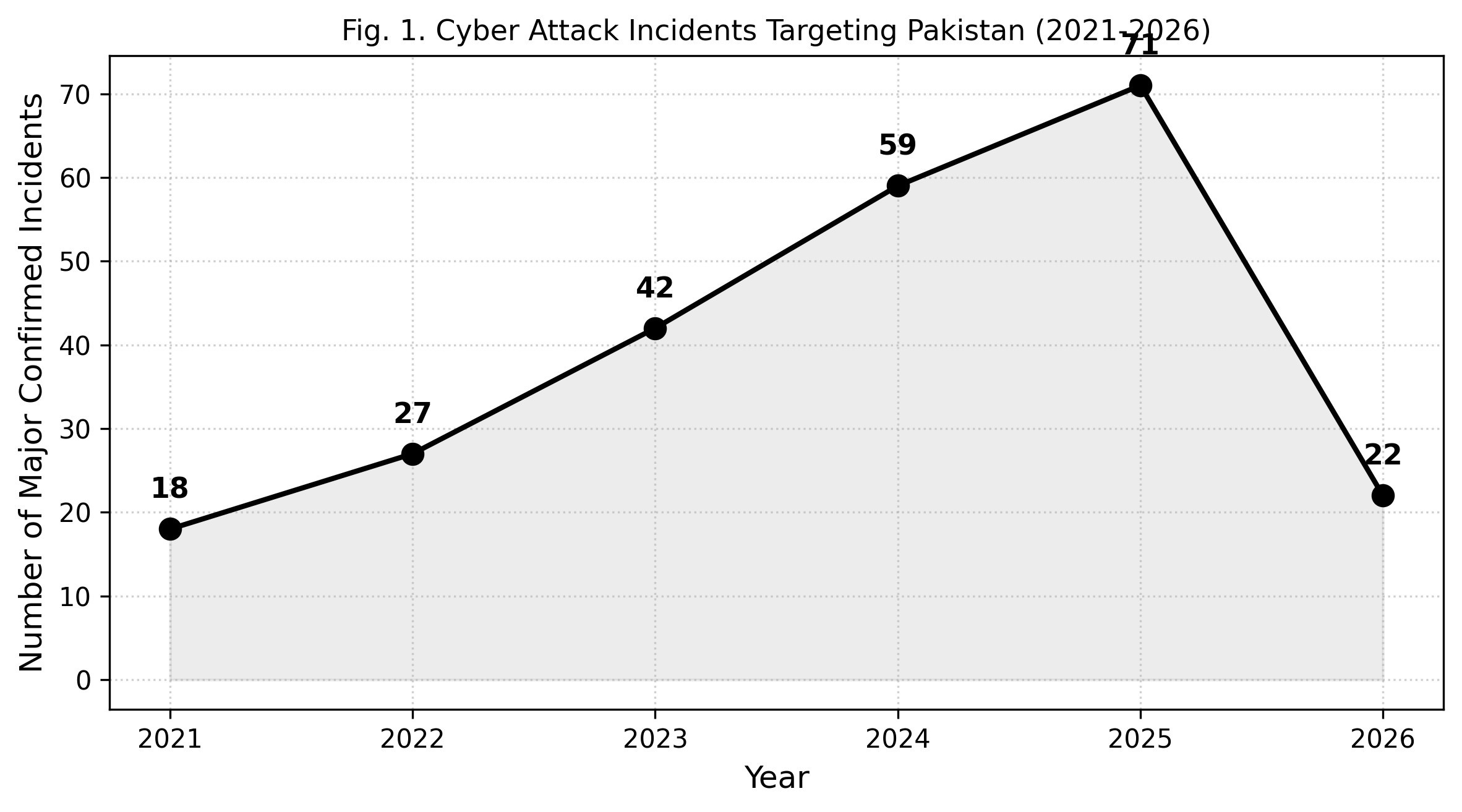
During the period between 2021 and 2026, the situation regarding cyber-attacks against the government bodies, banking platforms, telecom networks, and identity related systems steadily escalated in Pakistan. This paper examines 239 reported cases during the same time and establishes an increment in the frequency of attacks by 294.4 percent between 2021 and 2025. Data breaches that comprise 32.6 percent of all incidents and accumulated privacy exposure of about 744.6 million compromised records shows that the evidence gathered is comprehensive. To go beyond description, the research uses a Privacy Risk Score (PRS) tool in six types of attacks, namely, data breaches, ransomware, phishing and social engineering, distributed denial-of-service attack, website defacement, and advanced persistent threat. The review of the literature provides the basis of the analysis upon Pakistani legal, governance, and technical setting, whereas the experimental section examines the framework of a layered countermeasure structure guided by anonymization, adaptive privacy protection, AI-facilitated detection, and embedding of IoT security. The simulated PRS comparison indicates that privacy risk has been decreased by 84.2 percent when the suggested controls bring down the aggregate Privacy Exposure Index by 92.88 to 14.64. This paper thus provides a policy-relevant and data-supported framework of comprehension on cyber-attacks in Pakistan and its connection of sectoral exposure to the actual countermeasures.
Downloads
Published
Issue
Section
License
Copyright (c) 2026 Muhammad Imran Ghafoor, Muhammad Sohaib Roomi, Mehmood Baryalai,, Zubair Zaland, Iqra Tabassum, Aliza Sohail

This work is licensed under a Creative Commons Attribution-NonCommercial-NoDerivatives 4.0 International License.
How to Cite